
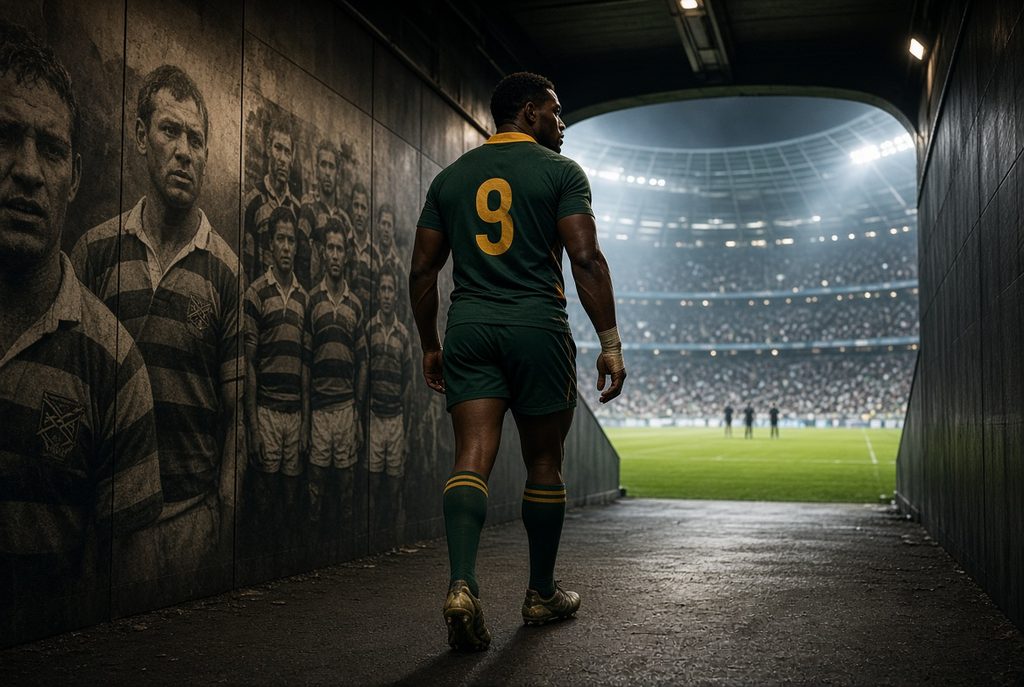
Rugby: Past, Present & Future — From Springbok Legacy to the 2027 World Cup
South African rugby is in another defining moment.
The Springboks have just beaten the All Blacks 3–1 in Rugby’s Greatest Rivalry, winning the final Test 43–28 in Baltimore to close out a six-week, eight-match tour that brought one of international rugby’s greatest rivalries back to life.
But the significance of that series goes beyond the scoreline.
It connects generations of rugby — from the Springboks who helped shape post-apartheid South Africa, to the World Cup-winning teams of 2007, 2019 and 2023, to a new generation now being developed with another World Cup only a year away.
For South Africa, rugby has always been about more than what happens for 80 minutes.
It is history. It is identity. It is rivalry. And increasingly, it is about what comes next.
This is Rugby: Past, Present & Future.
THE PAST: Where the Springbok Story Began
South Africa first played Test rugby in 1891, but the modern Springbok story changed forever when the country hosted the 1995 Rugby World Cup.
It was South Africa’s first appearance at the tournament after its exclusion from the first two World Cups because of international sporting isolation.
The Springboks went all the way to the final.
Facing New Zealand at Ellis Park, Francois Pienaar’s team won 15–12 in extra time, with Nelson Mandela presenting Pienaar with the Webb Ellis Cup in one of the most recognisable moments in South African sporting history.
That image became bigger than rugby.
It represented a country trying to define itself differently.
But the 1995 triumph wasn’t the end of the story.
It was the beginning of a new Springbok era.
2007: The Second World Cup
Twelve years after that famous home victory, South Africa lifted the World Cup again.
The 2007 Springboks defeated England 15–6 in the final in Paris, with John Smit leading the team.
The victory proved that 1995 had not been a once-off sporting fairytale.
South Africa had become a genuine rugby powerhouse.
2019: A New Era Begins
The next transformation arrived in Japan.
Under coach Rassie Erasmus and captain Siya Kolisi, the Springboks defeated England 32–12 in the 2019 final.
Kolisi’s captaincy carried enormous significance, but the rugby itself was just as important.
South Africa had developed a modern approach built around physicality, tactical kicking, set-piece pressure, defensive discipline and an increasingly sophisticated understanding of how to manage Test matches.
The Springboks had found a formula that worked at the highest level.
And they weren’t finished.
2023: Four-Time World Champions
Four years later, South Africa did something no men’s team had done before.
They won the Rugby World Cup for a fourth time.
The 2023 final against New Zealand in Paris finished 12–11, giving the Springboks their fourth Webb Ellis Cup after previous victories in 1995, 2007 and 2019.
It also made South Africa the first nation to win four men’s Rugby World Cups.
That achievement changed the way the current generation must be viewed.
This isn’t simply a good Springbok team.
It is one of the most successful eras in international rugby history.
THE RIVALRY: Why South Africa vs New Zealand Is Different
If there is one rivalry that defines the international game, it is the Springboks against the All Blacks.
The two nations first met in Test rugby in 1921. More than a century later, their matches remain among the biggest occasions in the sport.
There is history everywhere.
There are the great tours.
There are the World Cup finals.
There are the iconic players.
And there are the completely different rugby cultures that have developed on either side of the Tasman.
New Zealand traditionally represents speed, skill, continuity and attacking imagination.
South Africa has long been associated with physicality, forward dominance, defence and tactical control.
But those stereotypes are becoming less useful.
The 2026 series showed why.
THE PRESENT: The Springboks Are Still No. 1
South Africa entered the final Test of Rugby’s Greatest Rivalry as the world’s No. 1-ranked team.
They left Baltimore with an even stronger claim to that position.
The 43–28 victory lifted the Springboks to a record 95.09 World Rugby ranking points, while their lead over New Zealand grew to almost four points.
The final result also completed a remarkable turnaround.
New Zealand won the opening Test in Johannesburg.
South Africa then responded by winning the next three.
The final scoreline: Springboks 3–1 All Blacks.
That is important because the Springboks didn’t simply overpower New Zealand.
They adapted.
The New Springbok Attack
For years, one of the easiest ways to describe South Africa was through its power.
That description is still accurate — but it is no longer complete.
The 2026 series showed a Springbok side increasingly comfortable moving the ball and attacking with greater variety.
The forwards are not simply carrying into contact.
They are passing.
Backline players are operating in different positions.
The team is finding ways to create space while retaining the physical foundation that has made South Africa so difficult to beat.
The final Test in Baltimore was particularly revealing.
South Africa scored six tries in the 43–28 victory, with Damian de Allende, Morné van den Berg, Malcolm Marx, Pieter-Steph du Toit, Kurt-Lee Arendse and Cameron Hanekom all crossing the line.
That is a very different-looking Springbok attack from the caricature of a team that simply wins through forward pressure and kicking.
And that evolution could be crucial in 2027.
The Next Generation Is Already Arriving
Every successful team eventually faces the same problem:
How do you replace the players who built the dynasty?
South Africa may already be answering that question.
Players such as Morné van den Berg and Cameron Hanekom have emerged as part of a younger generation capable of contributing immediately rather than waiting several years for their opportunity.
That matters because the 2027 World Cup is not simply about selecting the strongest possible team today.
It is about building a squad capable of surviving an entire tournament.
Injuries happen.
Form changes.
Players retire.
And knockout rugby can punish even the smallest weakness.
South Africa’s depth could ultimately become one of its greatest advantages.
The All Blacks Have Work to Do
The 3–1 result is a major statement from South Africa, but it does not mean the All Blacks are finished.
Far from it.
New Zealand won the opening Test in Johannesburg and repeatedly showed the attacking quality that has made the team one of the sport’s traditional powers.
The challenge now is turning those flashes into consistency.
The All Blacks remain No. 2 in the world, behind South Africa, after the Baltimore result.
And there is a bigger reason not to write them off.
The 2027 World Cup is still ahead.
A year in rugby can change everything.
What’s Next for the Springboks?
The immediate future is Australia.
The Springboks travel to Perth to face the Wallabies at Optus Stadium on Sunday, 27 September 2026. Kick-off is scheduled for 5:30pm local time, which is 11:30am South African time.
That match will be another useful indicator of where South Africa stand against one of the teams they could encounter in the wider 2027 World Cup picture.
Then comes the European leg of the 2026 Nations Championship.
South Africa are scheduled to face:
- Italy — 7 November 2026
- France — 13 November 2026
- Ireland — 21 November 2026
The Nations Championship Grand Finals weekend follows at Twickenham at the end of November.
Those matches will give Rassie Erasmus more opportunities to test combinations, manage his squad and identify the players who can carry the Springbok jersey into 2027.
THE FUTURE: Australia 2027
Everything is now pointing towards Australia.
The 2027 Rugby World Cup will be the biggest test of this Springbok generation.
South Africa will enter the tournament as defending champions and will attempt something no men’s team has achieved:
Three consecutive Rugby World Cup titles.
The Springboks are in Pool B, alongside Italy, Georgia and Romania.
Their opening match is scheduled for 3 October 2027 against Italy at Adelaide Oval.
They then face Georgia on 10 October before completing their pool campaign against Romania.
On paper, South Africa have avoided some of the more difficult potential pool combinations.
But World Cups are rarely won on paper.
The 24-Team World Cup
Australia 2027 will also look different from previous tournaments.
For the first time, the men’s Rugby World Cup will feature 24 teams, divided into six pools of four.
That expansion creates opportunities for emerging rugby nations while giving established teams another challenge: there will be less room for complacency.
The tournament is also part of a wider attempt to make rugby more global.
Australia will host in 2027.
The United States will host the men’s World Cup in 2031.
And the 2026 Springboks–All Blacks series finale in Baltimore was part of that wider push to take elite rugby to new audiences. The revived South Africa–New Zealand tour is also expected to return in four years.
What Happens to the Springboks After This Generation?
This may ultimately be the biggest question.
South Africa’s recent success has been driven by a remarkable group of players and an equally influential coaching structure.
But no era lasts forever.
The next phase will involve deciding which veterans remain essential, which younger players take over and how the team maintains its standards when some of its biggest personalities eventually move on.
That transition has already started.
The fact that South Africa can introduce younger players while remaining the world’s No. 1 side suggests the system beneath the current team is healthy.
The challenge is maintaining it.
Rugby Beyond the Springboks
South African rugby is bigger than the national team.
The Bulls, Stormers, Sharks and Lions remain important parts of the country’s professional rugby ecosystem through the United Rugby Championship.
That competition provides South African players with regular exposure to European opposition and gives the national selectors another pool of talent to monitor.
It also means South African rugby fans have a story to follow throughout the year — not only when the Springboks are playing.
Then there is women’s rugby.
The Springbok Women are also building their own story, with the team entering the 2026 WXV Global Series and continuing to grow after reaching the quarter-finals of the 2025 Women’s Rugby World Cup.
The future of South African rugby will ultimately depend on the strength of all those pathways.
Rugby Is Entering a New Global Era
The 2026 rivalry series also revealed something bigger about where rugby is heading.
The final Test wasn’t played in Johannesburg, Cape Town or Auckland.
It was played in Baltimore.
More than 68,000 people attended the match, putting the Springboks and All Blacks in front of a major American sporting audience.
That matters because the United States is scheduled to host the 2031 men’s Rugby World Cup.
Rugby is therefore entering a period where traditional rivalries and established rugby nations will have to coexist with a push into new markets.
For fans, that could mean more major international matches outside the sport’s traditional heartlands.
For the game itself, it could mean a much larger global audience.
So, Where Does Rugby Go From Here?
That’s what makes the current moment interesting.
The past gave the Springboks their identity.
1995 changed what rugby could mean in South Africa.
2007 proved the first triumph could be repeated.
2019 created a new era.
2023 established South Africa as the most successful men’s Rugby World Cup nation.
The present has the Springboks sitting at No. 1 after a 3–1 victory over the All Blacks.
But they are no longer simply winning through brute force.
The attack is evolving.
Young players are coming through.
And the competition is watching.
The future is Australia.
The 2027 Rugby World Cup represents a chance to create another piece of rugby history — and potentially the biggest achievement yet.
Three consecutive World Cup titles.
No men’s team has done it.
The Springboks now have the opportunity.
But first comes Australia.
Then Italy, Georgia and Romania.
Then the knockout stages.
Then the pressure.
And somewhere beyond all of that is the question that will define this generation:
Can the Springboks become the first team to win the Rugby World Cup three times in a row?
For now, South Africa remains the team everyone else is chasing.
And that is what makes the next chapter worth watching.
Rugby: Past. Present. Future.
At TopBetZA, rugby coverage isn’t only about the next result.
It’s about understanding the story behind it — the players, rivalries, teams, history and moments that continue to shape the sport.
From the Springboks and All Blacks to the URC and the road to Australia 2027, this is where the next chapter begins.
Past. Present. Future. Rugby.
Frequently Asked Questions
How many Rugby World Cups have the Springboks won?
The Springboks have won the men’s Rugby World Cup four times: 1995, 2007, 2019 and 2023. They are the most successful men’s team in Rugby World Cup history.
Who won the 2026 Springboks vs All Blacks series?
South Africa won Rugby’s Greatest Rivalry 3–1. New Zealand won the opening Test, but South Africa won the next three, including a 43–28 victory in Baltimore.
Who is the No. 1 rugby team in the world in September 2026?
South Africa are currently ranked No. 1 in the men’s World Rugby rankings with 95.09 points, ahead of New Zealand.
When is the next Springboks match?
South Africa’s next men’s Test is against Australia on 27 September 2026 at Optus Stadium in Perth.
When is the 2027 Rugby World Cup?
The 2027 Rugby World Cup will be hosted by Australia, with the tournament beginning in October 2027. It will feature 24 teams for the first time.
Who are South Africa’s opponents at the 2027 Rugby World Cup?
South Africa are in Pool B with Italy, Georgia and Romania.
Can the Springboks win three Rugby World Cups in a row?
Yes. South Africa will enter the 2027 tournament as defending champions after winning in 2019 and 2023. A third consecutive title would be unprecedented in the men’s Rugby World Cup.
Why is South Africa vs New Zealand such a big rugby rivalry?
The Springboks and All Blacks have been playing each other since 1921, with the rivalry developing into one of the defining contests in international rugby. Their history includes major tours, World Cup finals and more than a century of competition.
What is the future of South African rugby?
The immediate focus is the 2027 Rugby World Cup, but South Africa’s future also depends on developing the next generation through international rugby, the United Rugby Championship and the women’s game.